Showing posts with label Bray. Show all posts

Saturday, December 29, 2012

Bray Family :: Index to Posts

An Index Post is how I keep track of all of the blog posts that have been written on a family line.  It helps keep me organized and allows visitors to easily find information on that family. This post will be updated as new blog posts are written on the family.

Henry Bray is my 5th great-grandfather (times two). His daughter Margaret as well as his son John are my 4th great-grandparents. Margaret married James Ball and their daughter Susanna married Samuel, son of John. Yes, Susanna and Samuel were first cousins. At least it reduces the number of ancestors that need to be researched! At the time of his death, Henry's wife was named Cathryn. It is not known whether or not she was the mother of any or all of  his 11 known children.

Naomi Bray, daughter of Samuel and Susanna (Ball) Bray, married Charles Wiseman in 1849 in Switzerland County, Indiana. They were the parents of five children - their son, Samuel Bray Wiseman is my great-grandfather.

Henry Bray - 5th Great Grandfather
John Bray - 4th Great Grandfather
  • A Day with a Distant Cousin! - November 10, 2010 - I met up with Jesse, a descendant of John Bray and his second wife Elizabeth Coones (or Coonis or Coonies). Includes an image of their marriage record from Gallatin County, Kentucky.
These three posts document the information known about John Bray and when he settled in Switzerland County, Indiana. Research done for possible submission to the Territorial Guard Society of Indiana.
Samuel and Susanna (Ball) Bray - 3rd Great Grandparents
  • The Marriage of Samuel Bray and Susanna Ball - May 23, 2012 - A visit to the Clerks Office in Owenton, Kentucky results in finding the original Permission Slip and Ministers Return for the marriage of Samuel and Susanna.
Naomi (Bray) and Charles Wiseman, 2nd Great Grandparents

Published under a Creative Commons License.
Becky Wiseman, "Bray Family :: Index to Posts," Kinexxions, posted June 2, 2012 (http://kinexxions.blogspot.com/2012/06/bray-family-index-to-posts.html : accessed [access date])

Originally posted June 2, 2012. Post date adjusted December 29, 2012 so that when a search for the surname is done on the blog the post will appear first the search list.

Friday, June 01, 2012

Switzerland County :: Wiseman-Bray Marriage

During my recent jaunt "down south" I spent a few days in Southern Indiana doing a bit of research for myself and my friend Cindy. My primary objective was to get a copy of the marriage record for my 2nd Great Grandparents, Charles Wiseman and Naomi Bray.

I had been to Switzerland County for research several times in the past and was really not looking forward to going to the Courthouse. My memories of the "genealogy" room were not pleasant. It was a small, dark, musty, dank, malodorous room in the basement. The large volumes were not organized in any way and it was not an easy task to locate the desired book.

I seem to recall that it had a dirt floor too, but maybe only a portion of the it was dirt. At any rate it was a terrible place for research. The room wasn't big enough for more than two people at a time and if photocopies were needed you had to carry the books (you know the very large, heavy volumes) up two flights of stairs and then wait for the Clerk to take the time to make the copies. During a previous visit in 1999 I attempted to use the digital camera for copies but there just wasn't enough light in the room. So I pretty much simply transcribed or abstracted the necessary information.

But, thankfully, that has changed. Even though all I wanted was a marriage record, I was told to go to the Recorder's Office. The clerk on duty that day was very nice though she wasn't the one who normally helps genealogists. She took me down to the basement to a well-lighted, organized room. I made a comment about how nice it was compared to the last time I visited. She laughed and said it's good that things change! I heartily agreed with her.

It only took a minute or two to locate the right book. I had left the camera in the car not knowing if it could be taken into the Courthouse and expecting the records to be in that old nasty room. I also expected to have to take the book upstairs but no, there was a copy machine right there! An old one, but it worked just fine - after we spent a few minutes trying to get it to work. At any rate, with copy in hand, I left with a smile on my face! And then I had a fun time driving the narrow back-roads up and down and through Switzerland County.


Switzerland County, Indiana Marriage Records "1846-1849" (No Volume Number) page 422. There are two volumes that include the year 1849, this record is from the "small" book.
"State of Indiana Switzerland County SS

"Be it remembered that on the 7th Day of Augt 1849 the Clerk of the circuit Court of said County Granted Charles Wiseman & Naomi Bray Marriage Licence which reads in the words and figures following towit State of Indiana Switzerland County SS

"The State of Indiana to any person duly empowered by law to Solomnize Marriages in Said County Greeting

"This is to certify you to join together in the holy bonds of Matrimoney as husband and wife Mr Charles Wiseman and Miss Naomi Bray and for so doing this shall be your sufficiant warrant
"Witness William Patton Clerk of the circuit Court of said County and the Seal thereof hereto attached at Vevay this 7th day of Augt AD 1849 [signed] William Patton Clerk PT [?]

"And afterwards to wit on the 3rd day of November 1849 the following Certificate was filed;

"This is to certify that I did on the 9th of August 1849 Join together as Husband and wife Charles Wiseman and Naomi Bray. this given under my hand this 11th Aug 1849 [signed] Joseph Hawkins a M. G."
Published under a Creative Commons License.
Becky Wiseman, "Switzerland County :: Wiseman-Bray Marriage," Kinexxions, posted June 1, 2012 (http://kinexxions.blogspot.com/2012/06/switzerland-county-wiseman-bray.html : accessed [access date])

Wednesday, May 23, 2012

The Marriage of Samuel Bray and Susanna Ball

In looking over the documents that I have on the Bray family, I realized that I did not have the marriage record for Samuel Bray and Susanna Ball, my 3rd great grandparents. They also happen to be first cousins. Samuel was the son of John and Nancy Bray while Susanna was the daughter of James and Margaret (Bray) Ball. John and Margaret were the children of Henry Bray.

I don't know how I missed getting their marriage record when I was last there in 1999! Anyway, on the drive back to Indiana from Nelson County, Kentucky I stopped at the courthouse in Owenton, Owen County, which is south of Gallatin County which is directly across the Ohio River from Switzerland County, Indiana. On the south wall of a small room in the Clerk's office were several shelves of marriage books. There was a very large marriage register that simply listed the marriages in date sequence, giving the names of the brides and grooms for each marriage and stating whether a bond had been filed.

Looking closely at the books on the shelves I saw that there were some books of Minister Returns and for Permissions. After a bit of searching, I found the books for the time period that Samuel and Susanna were married - 1821. I was pleasantly surprised when I opened the book for the Permissions as it contained the original documents! The individual slips of paper were encapsulated in plastic with four or five per page and they were filed by year, sort of.

Susanna Ball would have been 23 years old and Samuel Bray was 24 at the time of their marriage. Since she was over the age of 21, I really didn't expect to find a permission slip, but it was quite interesting to look at the documents. So it was pretty cool when I found the small slip of paper where James Ball gave his consent for Samuel Bray to marry his daughter! The only other record that I had that she was the daughter of James and Margaret was a transcription of Bible pages in Margaret's widows pension file. The only factor that I can think of as to why a permission slip would be needed for their marriage is that they were first cousins. What other reason would there be for needing a permission slip if both parties were over 21 years of age?

“I do hereby certify that James Ball consented in my presence that Samuel Bray Should intermarry with his daughter Susannah Ball. Augt 29th 1821. Jacob Ball.” (Owen County, Kentucky Permission Slips 1819-1853 accessed May 19, 2012.)
Having had success with the Permission Slips, I moved on to the Minister Returns. It also contained the original documents, which were somewhat larger slips of paper encapsulated in plastic.

“Kentucky Owen County
I James Medley a minister of the gospel legally authorised to Solemnize marriage do Certify that pursuant to a licence Issued from the office of the Clerk of Owen County Court I this day joined in marriage Samuel Bray of the state Indiana and Susannah Ball of said County given under my hand this 29th day Augu 1821 [signed by] James Medley” (Owen County, Kentucky Minister Returns 1819-1836 accessed May 19, 2012.)
The drive from Bardstown to Owenton on the state roads through the hills of Kentucky was beautiful - especially with the sunshine and blue skies. But the icing on the cake was finding these documents... it was definitely a fruitful day. And yes, I had to restrain my enthusiasm while at the Clerks Office but a little “happy dance” ensued once I got out to the parking lot!

Published under a Creative Commons License.
Becky Wiseman, "The Marriage of Samuel Bray and Susanna Ball," Kinexxions, posted May 23, 2012 (http://kinexxions.blogspot.com/2012/05/marriage-of-samuel-bray-and-susanna.html : accessed [access date])

Tuesday, May 22, 2012

Locating the Ancestral Lands in Kentucky

After leaving Cincinnati on Sunday after the NGS Conference, I headed a little further south and west to Bardstown, Nelson County, Kentucky. One of my “goals” was to see if I could determine where the land of Henry Bray was located. Henry is my 5th great-grandfather (times two). His daughter Margaret as well as his son John are my 4th great-grandparents. Margaret married James Ball and their daughter Susanna married John's son Samuel. Yes, they were first cousins. At least it reduces the number of ancestors that need to be researched!

Most researchers of this family put Henry's birth at about 1727 but, thus far, no record of his birth has been found and no other record has been found that indicates when or where he may have been born. Margaret, his first known child was born about 1753 (she was 83 years old when she filed for a widow's pension on September 2, 1836). The 1727 date for Henry's birth was likely estimated based on a probable age of 25 when he was married, assuming that he was married a year prior to the first child's birth. Henry's wife, Cathryn, was mentioned in his will of 1798. However, it is not known with certainty that she was the mother of his 11 children, the last of whom was born about 1770.

Various researchers put Henry's place of residence in the area of Washington County, Maryland and Hampshire County, Virginia (now part of West Virginia), which are only two counties away from each other. There is record of a Henry Bray signing the Oath of Allegiance in 1778 in Washington County, Maryland and a record of a Henry Bray enlisting in 1781 in Washington County, Maryland who was discharged as "unfit for service" several months later. But, again, it is not known for certain that this is “our” Henry Bray.

What is known is that Henry's son, Frederick, while residing in Hampshire County, reportedly enlisted along with his future brother-in-law, Edward Roberts in August 1776. Another son-in-law, James Ball, also enlisted in 1776 in Capt. William Voss' company while residing in Hampshire County, Virginia. A year later, Henry's son, John, just a little over 16 years of age enlisted in the same company. So it would seem that at least some of the children of Henry Bray were residing in Hampshire County, Virginia at the beginning of the Revolutionary War.

By 1790, Henry and 9 of his children had removed to the wilderness of what would become Kentucky, with most of them settling for a time in Nelson County. Tax Records show that John Bray was listed in Nelson County, Virginia in 1785 with 2 whites, 1 white tiths somewhere on “the southern waters of Rolling and Beech Forks westwardly of the the waters of Hardings Creek." In 1787 John Bray was listed with 1 tithable in “Pottinger's and Bean's Old Companies.”

On July 19th, 1788 John Bray was included in “A list of Tithes” in “Capt. Charles Reed's Company on Pottinger's Creek" with 3 tithables. Also listed were his brothers Peter and Daniel. Henry Bray shows up in the July 1790 taxlist as part of “Capt. Masterson & Willetts Company" along with sons John and Peter. All three were listed with 1 tithables. Various members of the family continue to appear in extant tax lists through 1799-1800 in Nelson County.

Enough of the background, now on to the land records of Nelson County...

In a land record dated July 30, 1790 and recorded August 8, 1803 (Book 6 pages 224-225) Henry Bray was bound to Aaron Atherton for £90. If Henry Bray conveyed a clear deed of 100 acres off the lower end of the “Survey whereon he now lives” to Aaron Atherton then the obligation would be void. The interesting thing to me is the fact that this record was dated July 30, 1790 while Henry Bray did not purchase the land “whereon he now lives” from Samuel and Anne Oldham until December 15, 1792 (recorded May 4, 1799 in Deed Book 5 pages 424-425).

Another record in Nelson County Deed Book 6 (pages 436-438) and dated July 14, 1805 is essentially correcting the deed that was recorded in 1792 between Henry Bray and Samuel Oldham because the description was in error...

The description of the land in the 1792 deed appeared to place the land on the south side of Pottinger's Creek (the bold-italicized text below indicates differences in the land descriptions in the two deeds):

“Beginning at Meshack Carters So. West Corner two honey Locusts on the Bank of Pottingers Creek extending thence with Carters line two Hundred and thirty three poles to his corner two Walnuts thence with his line South seventy eight West seventy one poles to two white Oaks thence South twelve Degrees West one hundred & eighty poles to three White Oaks thence West thirty poles to a Chesnut Oak & Double Maple thence South forty five West twenty eight poles to two White Oaks and Iron wood thence sixty three degrees West two hundred & eighty poles to two red Oaks & white Oak thence South 27ยบ E 173 poles to an Ash & prissimmon Tree on the Bank of Pottingers Creek thence up Pottingers Creek the meanders thereof to the Beginning.”

In actuality the land was on the north side of Pottinger's Creek as shown in the 1805 deed:

“Beginning at two Honey Locusts and a Hickory on the North Bank of Said Creek. Thence North twelve Degrees West two Hundred and twenty two poles to two Walnuts, thence North Seventy eight degrees East Seventy poles to two white oaks. Thence North twelve degrees West one Hundred and eighty poles to three White oaks thence North forty five Degrees West thirty poles to a Double Maple & Chestnut Oak, thence South forty five Degrees West eighty four poles to two white Oaks & an Iron Wood, thence South sixty two Degrees West two Hundred & eighty four poles to two Chesnut Oaks & a White Oak, thence South Twenty eight degrees East one Hundred and sixty Eight poles to a Persimmon & Beech on the bank of Pottingers Creek, thence up the same binding therewith to the Beginning.”

The 1805 deed also stated that the land was “near the Mouth of Pottingers Creek” and a little further into the deed it said it was “on the North Westardly side of Pottingers Creek.”

In addition, a deed dated November 23, 1807 in Book 6 pages 693-694 the land is described as being on “the North Bank of Pottingers creek.” In this deed, Aaron Atherton executor of the estate of Henry Bray, is selling 450 acres of land to Ignatius Clark, which bordered the 100 acres that had been “laid off for Abraham Bray,” son of Henry.

Regarding that 100 acres laid off for Abraham Bray... I don't have a copy of the deed but an entry in “Abstracts of Deeds 1803-1818 Nelson County, Kentucky” compiled by the Nelson County Historical Society (citing page 365 of Deed Book 11) shows that Aaron Atherton and wife Ann of Hamilton, Ohio sold 100 acres on the North bank of Pottinger's Creek “near the corner of Ignatius Clark” on September 12, 1806 to Abraham Bray. So it appears that Aaron Atherton received his 100 acres of land.

The will of Henry Bray was dated March 2, 1798 and was recorded in Nelson County, Kentucky Will Book A (pages 373-375). Aaron Atherton, named as the executor, filed his bond on July 9, 1799 and the estate was admitted to probate. All of the land transactions mentioned above were recorded in the Nelson County deed books as a result of the probate process.

With the information in the corrected deed, it has been shown that the land that Henry Bray purchased was “near the Mouth of Pottingers Creek” and “on the North Westardly side.” But where was Pottinger's Creek?


That answer was found in the Atlas of Nelson & Spencer Cos., Kentucky (D. J. Lake & Co., 1882). The above cropped and enhanced image shows the southern tip of Nelson county. The dark line going across the image is the Knoxville Branch of the L & N Railroad, which runs alongside Pottinger's Creek.


This road map provides a little perspective on the location, the area of New Haven and New Hope is circled in green.


A slightly different perspective from Google Earth with Nelson County outlined in blue. The squiggly meandering of the “Rolling Fork of the Salt River” creates the western border of Nelson County. The area of interest is outlined in red. All of those dark green areas are tree covered hills. It's pretty rugged countryside.


The topographical map above is a small portion of a map from the Libre Map Project website where they have digital maps for every state. (The individual files can be rather large and are a direct download when you click on your selected locality map.)

At this point it is not possible to determine exactly where the 550 acres of land purchased by Henry Bray was located. Considerably more research in the land records is required to bring ownership up to the current time and to locate the land in its proper place.

But based on the knowledge that it was “near the Mouth of Pottingers Creek” and “on the North Westardly side” I'm fairly confident that his land was within the red rectangular area in the above image.


I spent several pleasant hours one day driving around the area. I think the northern stretch of State Road 247, where it connects to State Road 52 just east of New Haven, goes through or nearest Henry's land. The terrain is hilly with narrow roads running through the valleys. There were numerous farms and fields - one farm had a sign posted stating it was a Kentucky Farmstead, established in 1785. I didn't take any photos during the drive since I was by myself and there really was no where to pull off alongside the road.

Published under a Creative Commons License.
Becky Wiseman, "Locating the Ancestral Lands in Kentucky," Kinexxions, posted May 22, 2012 (http://kinexxions.blogspot.com/2012/05/locating-ancestral-lands-in-kentucky.html : accessed [access date])

Sunday, May 06, 2012

It's Looking Better...

One day this past week was spent at the Allen County Public Library attempting to determine the validity of the statement made in an article by Carrie Bray in 1949 that her great-grandfather (my 3rd great-grandfather) John Bray had arrived in Indiana on March 5, 1816.

An affidavit by Daniel Bray in the Revolutionary War pension file of his father John Bray, stated that “Some time in the early part of the year 1816, he went to the land office of Cincinnati to enter the North East quarter of Section No 25, town No 2, range 3 West. That owing to some mistake in the land office he could not effect an entry and he was obliged to return home and that his father John Bray, then went to the office and entered the said quarter...”

So the “problem” was: When was the land actually purchased and why did Daniel state that it was in Range 3?

The book “Indiana Land Entries Volume I” by Margaret R. Waters, published in 1948, contains the records for Indiana that are from the Cincinnati Land Office. It covers the area known as the “wedge” in the southeast corner of the state.


The map above shows the status of the Indiana Territory in 1810 with the four counties in existence at the time: of Knox (Kn), Harrison (Har), Clark (Clk), and Dearborn (Dea). The “wedge” mentioned in the Waters book was the area known as Dearborn county in 1810 as well as neighboring portions of Clark County.


By 1814 there were a few more counties in the Indiana Territory. Franklin and Wayne counties were created in 1811 while Switzerland was created in 1814 from that Dearborn “wedge” area as well as from portions of other counties. The two maps above are from the Genealogy Inc. website.

In the introduction of her book, Margaret R. Waters states that the records were copied solely for genealogical purposes to enable a searcher to learn if an ancestor located in Indiana and if so, where and when. To save time and space the acreage and final certificate numbers were omitted. A minimum amount of information is given (name, property description, date of entry) but enough to determine if the person of interest entered land in what would become the state of Indiana.


At the top of page 79 was the entry for John Bray showing that he entered the “NE 1/4 of S25 on 3-5-1816”. The line just below John, includes the name of Edward Ray who may be the same person who married Jane Bray, daughter of John. The previous page (78) showed that the land was in Switzerland County in T2N, R4W of the 1st PM (Township 2 North, Range 4 West of the 1st Principal Meridian).


The map above (from the Waters book) shows the “wedge” area of land from the Cincinnati Land Office included in the book “Indiana Land Entries Volume I”.


This enlarged portion of the previous map shows the townships that comprise Switzerland County. The dotted lines show the boundaries of Switzerland and Ohio Counties. (Ohio County was created in 1844 from Dearborn.) The land that John Bray purchased was in T2N R4W, which is in that tiny red triangle bordering Range 3 West.


Portion of a Switzerland County Map from the My Indiana Home website showing the location of Braytown in Craig Township.

Luckily for me, the Allen County Public Library has a series of microfilms called “Ohio Land Records” which includes the records of the Cincinnati Land Office. Film OLR-110 contained “Cincinnati Land Office Entries, 1814-1829” and it was even indexed by page number. Most of the page numbers were missing or illegible but it didn't take long to find his entry since I had the date he entered the land.


Cropped portion of the page showing the entry for John Bray (last entry on the image). The date at the top shows the transaction was made on March 5th 1816. The text in the column on the right states “John Bray of Franklin County applied to enter the North East quarter of Section 25 Town 2 Range 4 West - Containing 159 44/100 acres and produces the Receiver's Receipt No 30668 dated this day for $79 72/100 amt [?] being the one fourth part of the purchase money of said quarter Section of Land.”

So it seems that the date of March 5, 1816 as given by Carrie Bray in her 1949 article correlates to the date of purchase of the land. It also confirms the statement made by Daniel Bray in his affidavit that he went to the land office in Cincinnati “some time in the early part of the year 1816”.

But there was a surprise in the land entry document - the statement that John Bray was “of Franklin County”.

In searching the web for information, I came across the site Cincinnati Land Office Records, which appears to be a part of the Ohio Memory project even though those records are not included in their list of collections. The site contains images of the original land patents issued to the purchasers. There are only a little over 300 documents currently online but it is going to be an awesome site when they get more documents published. Anyway, at the bottom of the second paragraph of “About this collection” it states
“In certain instances it has been impossible to determine the correct state of origin of the purchaser; generally this is due to the fact that both Indiana and Ohio have identically-named counties, such as Franklin County. In these cases, both Ohio and Indiana have been listed as the state of origin.”
So that might present a little problem. However, Franklin County, Indiana is so very close to Switzerland County while Franklin County, Ohio is further north and east, closer to the central part of Ohio. Since we don't know the whereabouts of John Bray between 1805 and 1816 (as mentioned in The Evidence at Hand) it is possible that he could have ventured further north, but I don't think so. Perhaps that is just wishful thinking on my part. If he was “of Franklin County, Indiana Territory” then that would be evidence that he was actually residing in the area and would definitely be eligible for membership in the Territorial Guard Society of Indiana.

We have the record of the land entry on March 5, 1816 and the statement by Daniel Bray that he, then his father John, went to the Cincinnati Land Office in the early part of 1816. Does that constitute enough evidence to be able to say that they were then residing in the Indiana Territory?

What other records exist during that time period that can be used to help substantiate the claim that John Bray resided in the Indiana Territory in 1816?

Published under a Creative Commons License.
Becky Wiseman, "It's Looking Better," Kinexxions, posted May 6, 2012 (http://kinexxions.blogspot.com/2012/05/its-looking-better.html : accessed [access date])

Wednesday, May 02, 2012

This Looks Promising...

As mentioned in the post The Evidence at Hand I am attempting to determine if my 4th Great-Grandfather, John Bray, would be eligible for the Territorial Guard Society of Indiana, which requires that he “lived within the boundaries of present-day Indiana on or before December 11, 1816 (the date Indiana was admitted to the United States).

I've been looking through the 78 pages of his pension file. Most of the documents pertain to his widow's attempts to receive his pension after his death in 1832. Long story short, she receives a pension, then she remarried in 1835 to John Bakes and lost the pension, he dies a few years later, and she reapplies for John's pension, which she receives until her death in 1876.

John had applied for a pension on June 20, 1818 through the Circuit Court of Switzerland County, Indiana (National Archives Pension File W 4145). His application was approved on August 9, 1818 and he was allowed a pension of $8 per month retroactive to the date of his application.

Of course, the documents were not in date sequence when they were microfilmed and subsequently digitized so it is like jumping back and forth in time (I'm also creating an index of the documents for future reference).

It doesn't appear to me that all of the documents relating to John's pension are in his file. There is a handwritten note stating “Suspended - See Letters to Claiment & Agent 16 Sept 1823.” Then written below that is “Suspension removed 6th Sept 1824 - See letters to agent & pensioner.” Those letters are not part of the images that were downloaded from what was then Footnote.com in 2007.

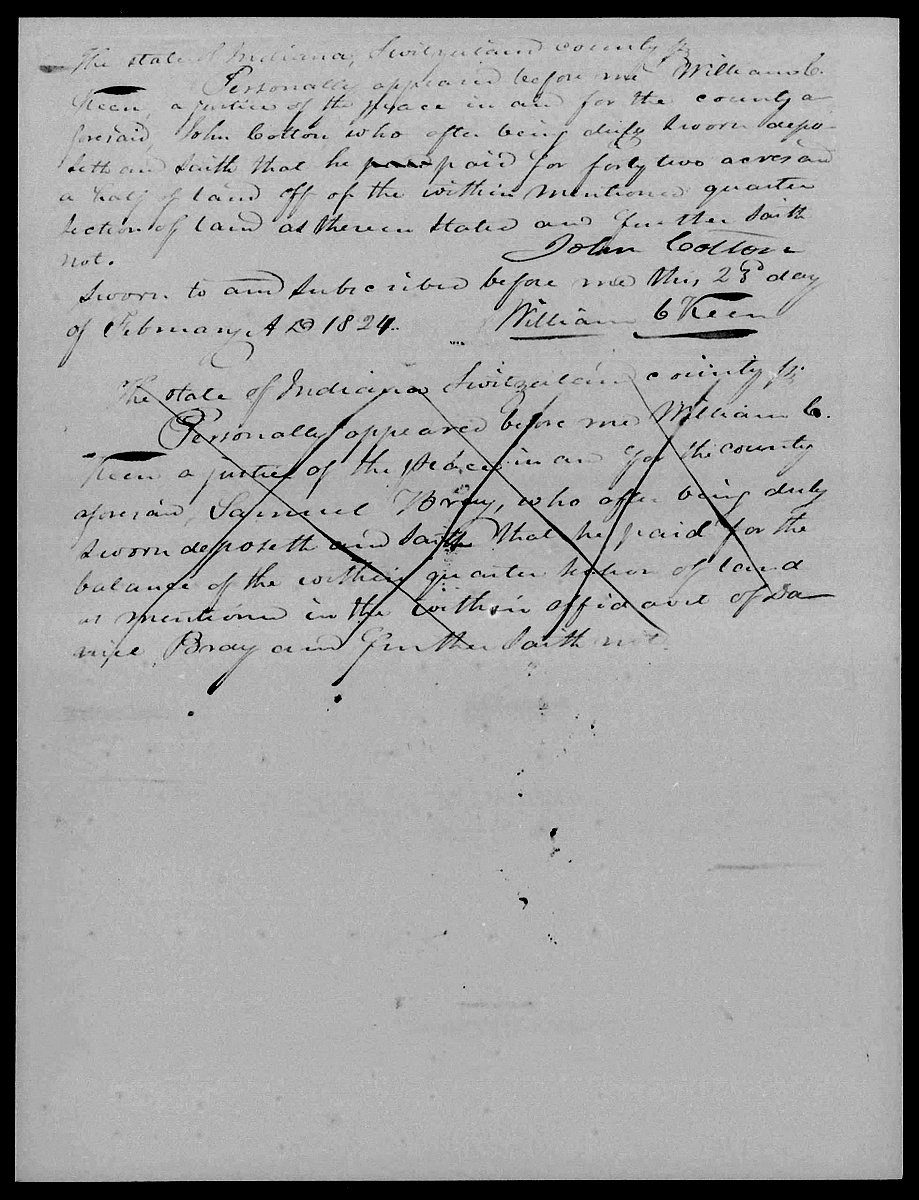
It was in the 76th image that I found a document dated February 24, 1824 that looks quite promising. I don't think it would be considered “proof of residence” on it's own merit, but it just might lead me to the document that could provide that proof! I believe it was created to validate the fact that John Bray was not a large landowner and as a result his pension was reinstated. The transcription is below and the images follow.

page 76:
The State of Indiana, Switzerland county SS 
Personally appeared before me William C Keen a justice of the peace in and for the county aforesaid Daniel Bray, of lawful age, who after being duly Sworn deposeth and Saith that Some time in the early part of the year 1816, he went to the land office of Cincinnati to enter the North East quarter of Section No 25, town No 2, range 3 West. that owing to some mistake in the land office he could not effect an entry and he was obliged to return home and that his father John Bray, then went to the office and entered the said quarter, in his own name instead of ours, that he paid the one half of the entrance money, and claimed the one half of the quarter, that the balance of the money was paid for the entering of said quarter by John Cotton and Samuel Bray, and they claimed the other half of said quarter - but on making the final payment, John Cotton, Samuel Bray and myself made an arrangement, so that I was to have and pay for but Sixty acres of the land - John Cotton was to have and pay for forty two acres and a half and Samuel Bray was to have and pay for the balance of the Quarter and was given the balance of the Money due from me on said quarter to John Bray, as it was entered in his name, to make the final payment for us and the land was patented in his name and he has since gave us our deed and further saith not. 
Daniel {his mark} Bray.
Sworn to and Subscribed before me this 23d day of Feby AD 1824. Willima C. Keen Justice of Peace.
It should be noted that Samuel Bray (my 3rd great-grandfather) is also the son of John Bray and John Cotton is his son-in-law, husband of his daughter Elizabeth.

page 77:
The state of Indiana, Switzerland County } SS 
Personally appeared before me William C. Keen, a justice of the peace in and for the county aforesaid, John Cotton, who after being duly Sworn deposeth and Saith that he paid for forty two acres and a half of land off of the within mentioned quarter Section of land as therein Stated and further saith not.
Sworn to and Subscribed before me this 23d day of February AD 1824. William C. Keen
The next paragraph on the same page has lines drawn through it...
The state of Indiana Switzerland county }SS 
Personally appeared before me William C. Keen a justice of the peace in and for the county aforesaid, Samuel Bray, who after being duly sworn deposeth and Saith that he paid for the balance of the within quarter section of land as mentioned in the within affidavit of Daniel Bray and further Saith not.
I have copies of the three deed transactions wherein the land in question (actually Section 25 Township 2 Range 4) was transferred in January 1823 to Daniel Bray, John Cotton, and Samuel Bray.
Switzerland County, Indiana Deed Book B p413. January 1, 1823. John and Elizabeth Bray sold to Daniel Bray 60 acres in S25 T2 R4 West for $120. Recorded November 29, 1823.
Switzerland County, Indiana Deed Book C p78-79. January 1, 1823. John Bray and Elizabeth Bray wife of the said John Bray... for the sum of ninety dollars sold to John Cotton forty two and a half acres in S25 T2 R4 West. No date given for when it was recorded. Deed prior to this one was recorded on September 15, 1825.
Switzerland County, Indiana Deed Book D p490-491. January 29, 1823. John Bray and Elizabeth Bray his wife sold to Samuel Bray for $50 Land off the north west Corner of the north East quarter of Section Twenty five Township two and Range four... The number of acres was not given. Date recorded was not given.

Document dated February 23, 1824 from Revolutionary Pension File of John Bray W4145.


Document dated February 23, 1824 from Revolutionary Pension File of John Bray W4145.

Next step? Records of the Land Office at Cincinnati...

Published under a Creative Commons License.
Becky Wiseman, "This Looks Promising," Kinexxions, posted May 2, 2012 (http://kinexxions.blogspot.com/2012/05/this-looks-promising.html : accessed [access date])

Monday, April 30, 2012

The Evidence at Hand

The Indiana Genealogical Society has a new lineage society that goes by the name of the “Territorial Guard Society of Indiana” which was formed in honor of the bicentennial of the War of 1812. To qualify you must be an Indiana Genealogical Society member who is a direct descendant of someone who lived within the boundaries of present-day Indiana on or before December 11, 1816 (the date of Indiana statehood).

In this previous post I stated that I have one possible ancestral candidate who could be considered - John Bray of Switzerland County - but the information I currently have that says he was here in 1816 is hearsay...

John Bray, my 4th Great-Grandfather, was born April 28, 1761 (251 years and 2 days ago - perhaps it is a “good omen” that I learned of the Territorial Guard Society on the 251st anniversary of his birth!). John Bray is a proven Revolutionary War Patriot who, thankfully, lived long enough to file for and receive a soldiers pension (filed June 20, 1818 in Switzerland County, Indiana). John enlisted in September 1777 in Romney, Hampshire County, Virginia as a Private in the company of Capt. William Voss - he was 16 years and 5 months old at the time of his enlistment. His pension application states that he participated in the battles of Brandywine (where he was wounded), Dela, Monmouth, in N. J. and in the taking of Stoney Point and in several small skirmishes. He was honorably discharged at York town in Pennsylvania in 1780 after having served three years, the length of his enlistment. John is buried at McKay Cemetery in Craig Township, Switzerland County, Indiana.

After the Revolutionary War, John Bray, along with his parents Henry & Cathryn Bray, and six of his adult siblings, some of whom had families of their own, left their home in Hampshire County, Virginia (now West Virginia) and moved into the wilderness of western Virginia, to the area that would become Nelson County, Kentucky.

Henry Bray begins appearing in tax lists for the area in 1790 with a deed dated December 15, 1792 showing him purchasing 550 acres of land on Pottinger's Creek (south of Bardstown). However, John Bray and several of his brothers begin appearing on the tax lists in 1785 when John is taxed on 2 whites, 1 white tith. “Somewhere on the southern waters of Rolling and Beech Forks, westwardly of the waters of Hardings Creek." It is thought that John and several of his brothers entered the area first while his parents and other siblings followed later.

In fact, John may have been the first of his family to go into the area that would become Kentucky. In February 1781, a John Bray was one of five men examined and found to be qualified for the office of Deputy Surveyor for Lincoln County (Virginia) “whereupon they took the oath of allegiance and the oath of office.” I don't know for certain that this is my John Bray - he would have only been 19 years old at the time. He would turn 20 on April 28th. (Lincoln County was one of three counties created in 1780 from Kentucky County, Virginia. The other two were Jefferson and Fayette. On November 29, 1784 Nelson County was created from Jefferson.)

Tax lists from 1785 through 1796 show that John Bray resided in Nelson County. He was listed as having 50 acres of land in only one year, 1793. I have not (yet) done land record research on him. A John Bray appears in the Hardin County tax lists for 1799, 1800, and 1805. It could be the same man - Hardin County borders Nelson county on the west and was formed in 1792 from part of Nelson county. It has been a few years since doing this research so other tax lists as well as other resources may have become available, but John seems to have “disappeared” for a while. In 1807, John is mentioned in a deed record along with his brothers and sisters, all of whom are listed as being “of Nelson County” Kentucky. However, it is known for certain that several of those siblings were definitely not living in Nelson County at that time.


Nelson and Hardin counties in Kentucky are circled in red. The blue circle is where Switzerland County, Indiana is located.

So where was John Bray after 1797 (or 1805 if he was the John Bray in Hardin County) and until June 20, 1818 when his pension claim was filed in Switzerland County, Indiana? At this time all I can say for sure is “I don't know.”

A few years ago my cousin Caroline found an article written March 20, 1949 by Carrie Bray of Vevay, Switzerland County, Indiana. Carrie was a great-granddaughter of John Bray through his son Daniel. I don't know if this is the full article, it is what I was given.

“The first blacksmith was Nathan Morgan and son Willis. Nathan Morgan and Nancy Morgan Bray are brother and sister. The braytown Christian church was built in 1850. Our father David Bray, helped haul the brick on Ox carts.

“Great grandfather Bray, revolutionist, enlisted Sept. 1777 in Romney, Va. His wife Nancy Morgan Bray, who died before coming to Indiana, so grandfather and four sons and two daughters - Nancy, Betsy, John, James, and Samuel, and Daniel - my grandpa, his wife, Catherine Wallace Bray and their 2 children, Susan who married Meshac Lanchmen and Benjamin, never married. These are the ones Braytown was named for. The state was created 4 days after their arrival, March 5, 1816. Mr. George Craig was one of the first settlers. Mr. James Shaw named the Post Office Craig after him. The first mail carrier was in 1870.”
I have very little information on Nathan Morgan - he is on my to do list and I consider him to be one of the members of the John Bray FAN Club. Nathan may be Family, if he is indeed a brother of the wife of John Bray. (As far as I can determine, the above article is the only “documentation” available that John's wife was Nancy Morgan. Of course, her name has been posted in numerous online trees as well, sans sources.) Nathan could also be an Associate as well as a Neighbor. What I do know is that he applied for a pension based on his service during the Revolutionary War. When he filed his application on June 7, 1832 he was 80 years old and a resident of Switzerland County.

Nathan Morgan stated that he entered service in 1777 or 1778 as a volunteer and served as a private in the Virginia Militia under Captain William Love. He marched to North Carolina, and was stationed part of the time in Chirels [?] Head Mine in Montgomery County, Virginia. He did not receive discharge papers and no one that he knows of that is living can verify his service. Nathan was born in the state of Delaware on the 22nd of October 1752 and he has evidence of birth at home in his father's records. Nathan lived in Virginia prior to enlisting and resided in Virginia two years after service. He then removed to Georgia and lived there 8 years, then to South Carolina for 3 years. He lived in Kentucky about 27 years and has lived in Indiana 20 years. [Abstract from Switzerland County Probate Record Book A, page 326] If he had been a resident of Indiana for 20 years in 1832, that means he came here about 1812.

According to published cemetery transcriptions, Nathan Morgan is buried in McKay Cemetery, the same cemetery as John Bray. Also according to the published transcriptions, Find A Grave, and several online trees as well as information from another researcher (way back in 1999 and 2000), Nathan Morgan died on September 4, 1839. However, when I was in Salt Lake City last October, I happened across a record for Nathan in Switzerland County Probate Order Book 1 (page 328) dated the 17th day of October 1835 in which Lewis H. Morgan was named Administrator of the estate of Nathan Morgan based on the report of Robert McKay the 3d that “fifteen days had fully Elapsed Since the death of the Said Nathan Morgan.” An online tree shows that Nathan had a son born October 24, 1809 named Lewis Howell Morgan. That tree lists 15 children born to Nathan, from 1776-1813 by two wives, both named Elizabeth!


Administration of the Estate of Nathan Morgan, granted to Lewis H. Morgan. Switzerland County Probate Order Book 1 (page 328) dated the 17th day of October 1835.

I don't know if pursuing additional information on Nathan Morgan will provide any clues as to when John Bray arrived in Switzerland County but it may well help with the identification of his wife, reported in the above article by Carrie Bray to be Nancy Morgan, sister of Nathan.

Reviewing the article by Carrie Bray a little further, she names the children of John Bray at the time he came to Indiana as “Nancy, Betsy, John, James, and Samuel, and Daniel” but she left out one daughter, Jane. Named in his will (dated June 26, 1832) were sons John, Daniel, and Samuel and daughters Jane Ray, Elizabeth Cotton, and Nancy Culver. Also named were his second wife Elizabeth, whom he married in 1820, and their three children George, Amelia, and Sophia.

In her article, Carrie says “The state was created 4 days after their arrival, March 5, 1816.” This is either an error on her part or a transcription error on the part of my cousin. I'm hopeful, but skeptical, that the date of March 5, 1816 is actually the date John Bray and family arrived in Indiana, which was admitted on December 11, 1816 as the 19th state of these United States. Do you think the evaluation committee for the Territorial Guard Society would allow John Bray to be admitted based on Carrie's story? Not likely...

I have three versions of the pension application of John Bray! Portions of the file were printed from microfilm in the late 1990s at the Allen County Public Library (those are stuck away in storage). Twelve pages (all that were available at the time) were downloaded in 2006 from Heritage Quest. Then in 2007 I downloaded 78 pages from Footnote (now Fold3). A few pages have been transcribed but nothing that gives any clues as to when he came to Indiana. I'll be reviewing those documents as well as the few land records that were obtained at Salt Lake City in October of last year. Maybe I'll get lucky and find something of use in his pension file!

Published under a Creative Commons License.
Becky Wiseman, "The Evidence at Hand," Kinexxions, posted April 30, 2012 (http://kinexxions.blogspot.com/2012/04/evidence-at-hand.html : accessed [access date])

Wednesday, November 10, 2010

A Day with a Distant Cousin!

Towards the end of October, I received an email from a gentleman who happens to be my fifth cousin or fourth cousin once removed – or something like that! A distant relative to be sure. He found me through the blog, or rather, his brother found me and told Jesse to contact me!

Jesse is a descendant of John Bray and his second wife, Elizabeth Coones (or Cooney or Coonie or Coonies or Coonis) through their daughter Sophia. I am a descendant of John and his first wife, reported to be Nancy Morgan, through their son Samuel Bray. John and Nancy are my 4th great grandparents.

Anyway, Jesse said he'd like to meet with me sometime. So, since I was headed south and Vevay was more or less on the way, I said I could stop by on the 9th. That also happened to be the only day this week he had free! Great timing, eh?

Me and my cousin, Jesse. November 9, 2010.
The Markland Dam and Ohio River in the background.

We spent a couple of hours at the Switzerland County Library in Vevay comparing information then took a drive to McKay Cemetery where John Bray is buried.

Jesse had a copy of the marriage record of John Bray and Elizabeth but it was difficult to read. The county seat of Gallatin County, Kentucky is Warsaw, which happens to be across the river a short distance east of Vevay. It was a beautiful day (sunshine and 70 degrees! In November!!) and the drive took just a few minutes.

The marriage records were in the office of the County Clerk located in a building behind the courthouse. The earliest marriage records were in a binder whose back had separated so all the pages were loose. Each page had also been laminated. The record for John Bray and Elizabeth is at the bottom of a page numbered 59. Rather than try to make a paper copy, I used my digital camera... (double click on the image to see a larger version).

Elizabeth's last name is in the middle of the fifth line from the bottom...

After examining the full page containing this and two other records, I think her last name is Coonis. The word directly beneath her name is Licens and is written the same way on the other two records on that page. It is definitely not Cooney, which is how it is transcribed in the published book.

At any rate, how it is spelled is probably a moot point, since what Jesse really wants to know is what is her maiden name! Elizabeth would have been about 18 years old and a widow when she married John Bray. There is no record of her first marriage in Gallatin County, Kentucky and we don't know what happened to her husband. John was 12 days shy of being 60 years old when he married Elizabeth. His youngest daughter by his first marriage was 16 years old – but she had been married the year before when only 15 years of age. So, John was an “empty nester” and perhaps didn't like living by himself...

John passed away on June 10, 1832 at age 71 – the three youngest children by his wife Elizabeth, were Amelia, George and Sophia – age 11, 9, and 3, respectively. Elizabeth was married for a third time to Robert Bakes on October 4, 1834. He passed away in 1847. Elizabeth died in 1876. The 1850 and 1870 census records show that she was born in Kentucky about 1798-1800, though Jesse has her birth year as 1802.

After a short visit to the library, Jesse and I stopped at Jewels, a little restaurant on Main Street in Warsaw, for a late lunch. The place was full with no empty tables, but a lady waved us over to her table saying we could join her and her husband. Turns out they were friends of Jesse! A rather nice coincidence. The food was good as was the company.

All in all, it was a delightful day. Thank you, Jesse, for inviting me to visit! It was a pleasure meeting you.

Tuesday, September 08, 2009

Tombstone Tuesday :: John Bray

John Bray is my one and only Revolutionary War ancestor who made it to Indiana. He is my 4th Great-Grandfather and is buried in McKay Cemetery, Craig Township, Switzerland County, Indiana.


John was born on April 28, 1761 probably in Maryland or Virginia to Henry and Cathryn Bray. According to other researchers, John's wife was Nancy Morgan, reportedly a sister of Nathan Morgan who also lived in Switzerland County. However, I have found no evidence to support those claims.

According to his pension record affidavit, John enlisted in 1777 in “Romley” Hampshire county, Virginia under Captain William Voss of the 12th Virginia regiment. He served three years and was honorably discharged at Yorktown, Pennsylvania by colonel Morgan. He was wounded in the battles of Brandywine (Delaware), Monmouth (New Jersey) and Stony Point (New York) and also participated in many other skirmishes.

In December 1784, John received a bounty land warrant for 100 acres of land for his three years of service and, with his father and several other siblings took up residence in what was then Nelson County, Virginia (it became Nelson County, Kentucky in 1792).

His first son, John Bray Jr. was born about 1787 so it has been assumed that he married his first wife about 1786 in Nelson County, Virginia but no record of the marriage has been found. It has been assumed that his first seven children were by this wife (presumed to be Nancy Morgan).

John and his children removed to Switzerland County, Indiana at about the time Indiana became a state (1816). On April 15, 1820 in Gallatin County, Kentucky (just across the Ohio River from Vevay) John was married to Mrs. Elizabeth Coones. They would have three (or four) children, the last one born just four years prior to John's death on June 10th 1832 at the age of 71.

John's will, dated June 26th 1832, names his beloved wife Elizabeth and children: the youngest son George Bray got the land. His three oldest sons (John, Daniel, and Samuel Bray) each received one dollar. The three oldest girls (Jane Ray, Elizabeth Cotton, and Nancy Culver) also received one dollar. The three younger girls (Pelina, Amealy, and Sophia Bray) were each given one bed and bedding.

George, Amelia, and Sophia were the children of his wife Elizabeth and perhaps, so was Pelina. We have no record of what became of her.

Much more information on John Bray as well as his siblings and children, can be found in my database on WorldConnect.