Showing posts with label Stoever. Show all posts

Saturday, October 27, 2012

The Old Trappe Church

On July 2, 1750 Joh Michael Hoffman (widower) was married to Engel Schedlerin in New Hanover township in what is now Montgomery County, Pennsylvania. The marriage was recorded in the records of the Augustus Evangelical Lutheran Church in Trappe, Pennsylvania.

If my theory is correct, Michael and Engel would be my 6th great grandparents. Regardless whether they are or not, one of the places I wanted to visit while in Pennsylvania was the Old Trappe Church. It is reportedly the oldest unchanged Lutheran church still in use in the United States.

According to information posted on the bulletin board outside the church, the congregation was organized about 1730 by John Caspar Stoever, Jr. (who happens to be one of my 5th great grandparents). Worship services were held in a barn loaned by one of the deacons. At that time Stoever was not a regularly ordained pastor but in 1732 he was ordained in the presence of the Trappe congregation. He remained there for a few years before moving on to Lancaster.

Stoever's departure left the spiritual care of the congregation in the hands of a series of self-styled itinerant pastors until late in 1742 with the arrival of Henry Melchior Muhlenberg. In January 1743, members of the congregation began hauling stones to the site and the structure was erected through the spring and summer months. The first service was held in the unfurnished interior on September 12, 1743. The building was completed and dedicated on October 6, 1745. The congregation organized formally, adopting the name "Augustus Lutheran Church." By 1752, the interior of the church building was completed as it appears today.

In 1814, the exterior stone walls were stuccoed and painted to help preserve the building. A woodstove and wooden floor was also added to the interior. In 1860, a severe storm destroyed half of the roof of the Old Church and there was discussion of razing the building but funds were raised to pay for the repairs. In the late 1920s the interior was restored to the colonial appearance with the removal of the stove and the addition of a concrete and flagstone floor. It is now listed as a National Historic site.

In 1852 a new brick church was built a short distance away. The new building  is the current church building  used by the Augustus Lutheran Church.

The walkway leading to the Old Trappe Church is embedded with plaques from other Lutheran churches around the world. All photographs were taken on October 9, 2012.

I was fascinated by the shape of the church building.


The raised graves/crypts next to the church building are for members of the Muhlenburg family.

 Burials in the cemetery reportedly date from 1729. The oldest legible stone, which I did not find, is dated 1736.

 Some of the windows still have the old wavy glass, though I doubt that the panes are from the early 1700s.

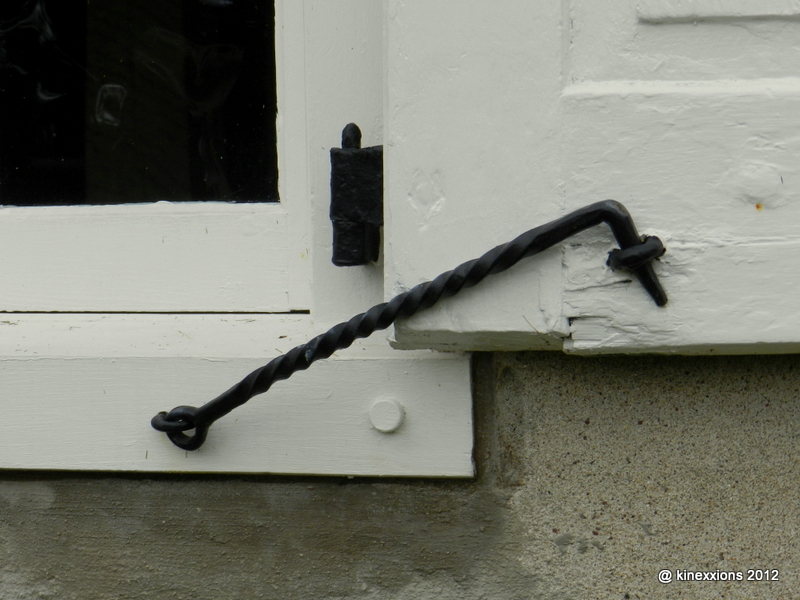
Detail of the braces used to keep the shutters open. 

I had not pre-arranged for a tour, so was unable to go inside. Shots of the interior were taken by carefully holding the camera up against the window panes. The pulpit on the left side is the only piece of furniture that was not handcrafted by local craftsmen using native woods. It was made of European red walnut and imported at the time the church was dedicated. The top piece over the pulpit is a 'sound board' that amplifies the preachers voice. The offering bags on the far wall were used in the 18th century.

A portion of the concrete and flagstone floor is visible as is the staircase leading to the second floor balcony.


I am always amazed by the craftsmanship and engineering skills of the early builders. Even if this is not The Church of my Hoffman ancestors, it was an incredible feeling to walk around it and to be able to see this magnificent Old Church.

Published under a Creative Commons License.
Becky Wiseman, "The Old Trappe Church," Kinexxions, posted October 27, 2012 (http://kinexxions.blogspot.com/2012/10/the-old-trappe-church.html : accessed [access date])

Wednesday, November 11, 2009

The Search for Hawksbill Church

Monday afternoon (November 2nd) found me back in Shenandoah County, Virginia - specifically Strasburg, Edinburg, and Luray - in search of that elusive church mentioned in my previous post!

On Wednesday (October 25th) I had made a detour from Shenandoah National Park to Luray, known for its caverns. But that isn't why I went there. I stopped at the library and got some assistance from one of the librarians. I was looking for the location of what in the 1700s and early 1800s was known as the Hoxbiel or Hawksbiel or Hawksbill Church. By 1848, when a new brick building was constructed, it was known as Mount Calvary Lutheran Church. The librarian provided a copy of transcriptions of the church register of baptisms and marriages but it was for a much later time period. But in the preface I learned that even though the congregation disbanded in 1959, the church building still existed and that it was located three miles south of Luray. However, none of the library staff knew where it was located.

The first two pastors that served the Hawksbill congregation were J. C. Stoever (Sr) from 1733-34 and J. C. Stoever (Jr) from 1734-42. They were Johann Caspar Stoever and were my 6th and 5th great-grandfathers, respectively. As stated in the previous post mentioned above, the elder man died at sea in 1739 while returning from a fund raising trip to Europe. The younger Stoever was a traveling pastor visiting and serving several congregations, often at the same time, in Pennsylvania (primarily in what was then Lancaster County, which encompassed a great deal more territory than it does today) and northern Virginia. Much has been written of his exploits and troubles regarding his pastorate and conflicts with his fellow clergymen. There is no way that I can possibly condense it all down so it would make sense in a brief blog post. A fairly complete accounting of his life can be found on pages 51-101 in "Stover-Stoever-Staver- Stiver, An Account of The Ancestry and Descendants of Johann Caspar Stoever of Pennsylvania" by Vernon Stiver & Patricia R. Donaldson, Saline, Michigan, 1992.

The fact that the two Stoevers were both pastor of this church was interesting but not too surprising given the fact that it wasn't all that far from Madison and the Hebron Lutheran Church, albeit on the other side of a mountain range! But what intrigued me more was the fact that another ancestor, 5th great-grandfather, Wilhelm Georg Forster aka William Foster, served as the eighth pastor of the Hawksbill Church from 1798-1806. The Stoevers are ancestors on my Dad's side of the family and William Foster is on my Mother's side.

I took the main road south from Luray (Business Route U.S. 340) thinking there might be a sign pointing the way. I got excited when I saw a sign for Hawksbill Primitive Baptist Church, until it sank in that it was a Baptist Church! I did stop at a gas station along the way, but no one there knew anything about Mount Calvary Lutheran Church, which wasn't surprising since it had closed in 1959. For another hour, I aimlessly drove along the back roads of the valley, hoping for some good luck but finding none, and not finding the church.

While staying with my aunt that weekend I spent some time at Panera Bread using their free WiFi (thank you very much – my aunt has dial-up access, sloooow) and found a pdf file which is an application for the National Register of Historic Places and which provided an exact location for Mount Calvary Church. I really wasn't concerned with finding the actual church so much as just wanting to see where it was located. The building itself held no meaning for me since it was built long after the Stoevers and Fosters were there.

To make a long story short, I returned to Luray after I left my aunt's place and found the church, sort of. I briefly saw the building through the trees high on a hill at the base of a mountain on a narrow, winding dirt road where there was no place to stop without blocking the road completely. I did see a dirt road (more like a trail) that led up the hill, but it was deeply rutted and overgrown and there was no way I was going to attempt to drive my van on it. I also chose not to walk up the trail since it was rather remote and rugged terrain. And I didn't get any pictures either. But I did satisfy my curiosity. It was really out in the middle of nowhere. Now and even moreso back then.

While pastor of Hawksbill, Wilhelm Foster also served as pastor of the Hebron Lutheran Church in Hampshire County, Virginia (now part of West Virginia) from 1797-1803. It is located on West Virginia route 259 between Capon Lake and Intermont (Photograph on wikipedia). And yes, I did make the drive and went to see where this church was located.

In 1796, Wilhelm Forster had purchased 289 ½ acres of land located on the "drains of Bauman Mill Run" outside of Strasburg, Virginia. It was from this central location that he served these two congregations. Strasburg is located midway between the Shenandoah and Blue Ridge Mountains, just below the northern end of Massanutten Mountain, which divides the Shenandoah Valley.

To get to Hawksbill he had to go over a portion of Massanutten. To get to the Hebron Church in Hampshire County, he had to cross over the Shenandoah Mountains. Both churches are about a distance of 25-30 miles from Strasburg. Over the mountains, through the rivers and forests. A distance that took me far less than an hour to travel probably took him several days. By spending the time to drive through the valley and over the mountains to locate the churches, I gained a greater appreciation for these pioneer ancestors.

Oh, and I also obtained the signature of Wilhelm Georg Forster. It was on the land record where he and his wife Magdalene were selling the land they had purchased in 1796. (Shenandoah County Deed Book Q page 43) They sold the land on July 4, 1807 prior to their move to Fairfield (now Perry) County, Ohio. In 1805 Wilhelm had been appointed as a traveling preacher in the Ohio district known as "New Pennsylvania" which included Fairfield (Perry), Muskingum, Pickaway and Ross counties.

Wednesday, November 04, 2009

John Caspar Stoever and Hebron Lutheran Church

The charming little town of Madison, Virginia lies on U.S. Route 29 about 10 miles south of Culpeper and 25 miles north of Charlottesville. A few miles north of Madison there is a small church that is significant for several reasons. The Hebron Lutheran Church is the oldest Lutheran Church in continuous use in the United States. Built in 1740, it is one of the few wooden churches surviving Virginia's colonial times. The first pastor of the congregation was my 6th great-grandfather, Johann Kasper Stöver aka John Caspar Stoever, in my father's lineage, on his mother's side.

Baptized January 18, 1685 in the Lutheran church at Frankenberg, Hessen (in present day Germany), Johann Kasper Stöver was the son of Dietrich and Magdalena (Eberwein) Stöver. Along with his son of the same name, he arrived in Philadelphia on September 11, 1728 aboard the ship James Goodwill with David Crockett as the ships Master.

Several years earlier, after fulfilling their obligations at the Germanna Colony, a group of German Lutheran colonists purchased land near what would later become the town of Madison. They settled there and carved out lives for themselves and their families. And in 1726, they built a small log chapel along the Robinson River. It wasn't until the spring of 1733 that they were finally able to secure the services of a minister - the Rev. John Caspar Stoever (Senior).

His time as pastor of Hebron, was short - only about a year and a half. But in that time he laid the foundation for the future growth and prosperity of the church. A new house of worship was badly needed. The chapel in which he preached had become too small for the growing congregation and unsuitable for church purposes. The means of his people were limited. After paying their pastor's salary and taxes for the support of the established church, they felt that the burden of building was too great for them to bear alone. It was finally decided to ask for help from their brethren across the seas. Thus it was that in the fall of 1734, Pastor Stoever, Michael Smith (an elder), and Michael Holt (a member of the congregation) were sent to Europe to solicit funds to aid in building a church, establishing a school, and supporting an assistant pastor.

The fund-raising trip was quite successful. Sadly though, on the return voyage to Virginia, in the spring of 1739, Pastor Stoever became critically ill and died at sea. Though constructed in 1740, after his death, the church building is part of the legacy of John Caspar Stoever as is a school built in 1748 - the first school for German speaking colonists in the South – that was used for 100 years.

This historical marker is on the right side of the road when traveling north on the Blue Ridge Turnpike (Virginia Route 231) and is a little south of Hebron Church Road (County Route 638).

The inscription reads “Nearby stands Hebron Lutheran Church. This cruciform church was built in 1740 and is America’s oldest church in continuous use by Lutherans. The congregation was formed by 1725 by German families, some of whom arrived to Virginia in 1717 to work at Germanna, Lieutenant Governor Alexander Spotswood’s frontier mining community. The church was enlarged about 1800 and a pipe organ crafted by David Tannenburg of Lititz, Pennsylvania, was installed. The interior of the church has elaborate frescoed ceilings painted by the Italian born artist Joseph Oddenino. It was listed on the Virginia Landmarks Register and the National Register of Historic Places in 1971.”

It was on Sunday morning (October 25th) that I was given a tour of the church by its historian, Mrs. Judy Ann Fray. Due to poor timing, I arrived after services were over but was extremely fortunate that Mrs. Fray was still there. And even more fortunate that she was gracious and willing to take the time to show me around.

Hebron Lutheran Church, Madison, Virginia. The parish house is to the right (east) of the church. The cemetery and stone fences date from the early 1900s.

The south side (front) of the church was added between 1790 and 1802. The small platform in front of the church was used for mounting and dismounting from horses and carriages. There are three of them, the one in front and one on each of the east and west sides.

The north side of the church (now the back) was built in 1740.

The pews and balcony on the east side, part of the original church building.

Installed in 1802 and restored in 1970, the Tannenberg organ is still in use today.

The southern side, added between 1790 and 1802. In the balcony area, where the organ was installed, you can see that the church originally had a high barrel-shaped ceiling.

The ceiling was lowered and plastered during renovations in 1850. In 1884, the ceiling was painted by Joseph Oddenino of Turin, Italy. Additional renovations were made in 1961.

Sources:
History of the Hebron Lutheran Church, Madison County, Virginia from 1717-1907 by Rev. W. P. Huddle, Pastor. New Market, Virginia, 1908. Pages 23-30.

Stover-Stoever-Staver-Stiver, An Account of The Ancestry and Descendants of Johann Caspar Stoever of Pennsylvania by Vernon Stiver & Patricia R. Donaldson. Saline, Michigan, 1992. Pages 11-49 provide an interesting and detailed accounting of the life of John Caspar Stoever, Sr.

Pamphlet published by the Hebron Lutheran Church, Madison, Virginia. No Date.